




Introduction to Trading
Objective: Understand what trading is, who the main market participants are, and why it is important to know how markets work.
This module provides the foundations to start understanding the world of trading. It will help you distinguish between trading and investing, learn about financial markets, and understand the mechanisms that determine prices.
What is Trading
Course Introduction and Objectives
- Course overview and module structure
- Learning objectives: understand the basics of trading, how markets work, and the main financial instruments
- Importance of building solid foundations before trading with real money
- Brief overview of what will be covered in the following modules

What Trading Means
- Definition of trading: buying and selling financial instruments to profit from price movements
- Most common financial instruments: stocks, currencies, indices, commodities, cryptocurrencies, ETFs, CFDs
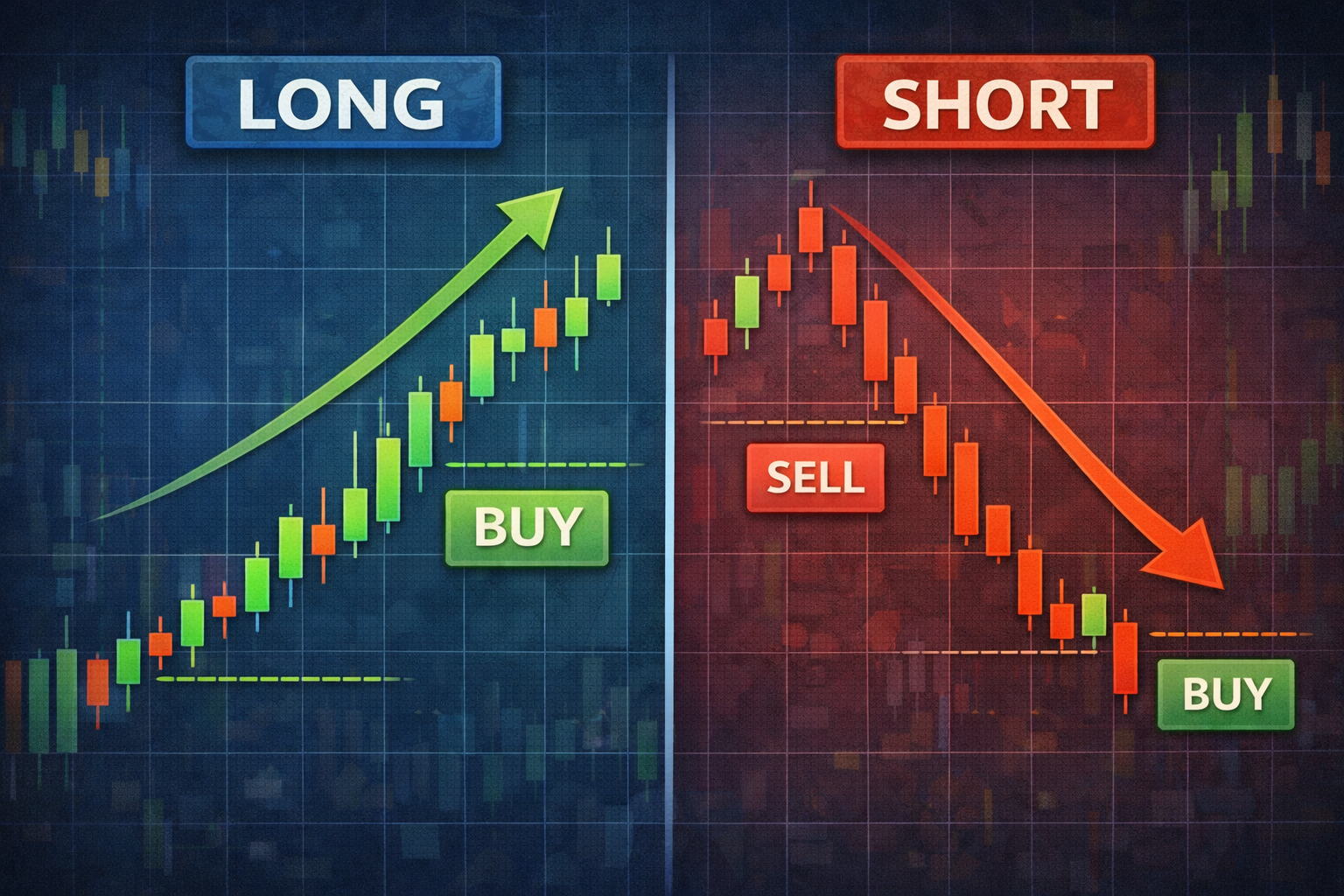
- Basic mechanism: buy low → sell high / sell high → buy back lower (long and short)
- Role of online platforms in providing access to markets
- Risk concept: every trade can generate profit or loss
Practical example: simple illustration of a long trade and a short trade on a candlestick chart.
Trading vs Investing – Key Differences
- Trading: short-term operations, frequent trades, based on price movements
- Investing: long-term horizon, focus on asset growth
- Technical analysis vs fundamental analysis
- Objectives: quick profits in trading vs capital growth in investing
| Aspect | Trading | Investing |
|---|---|---|
| Time horizon | Short | Long |
| Trade frequency | Many | Few |
| Main analysis | Technical | Fundamental |
| Objective | Quick profits | Capital growth |
Financial Markets
What Financial Markets Are
- Definition: places (physical or digital) where buyers and sellers exchange assets
- Main markets:
- Stock exchanges (e.g. NYSE, Italian Stock Exchange)
- Forex (foreign exchange market)
- Commodities and indices
- Cryptocurrencies
- Market functions: price discovery, liquidity provision, and investment opportunities
How Supply, Demand and Prices Work
- The price of an asset is determined by supply and demand
- High demand → price rises
- High supply → price falls
- Influence of economic events and news on price movements
- Introduction to support and resistance concepts
Liquidity and Volatility – Key Concepts
- Liquidity: how easily an asset can be bought or sold without affecting the price
- Liquid markets: Forex, major stocks, main indices
- Volatility: measure of the speed and magnitude of price movements
- Volatile vs stable markets: advantages and risks for traders
Market Participants
Objective: Learn who participates in financial markets and the role each actor plays. Understand how their actions influence prices and liquidity.
Traders and Investors
Retail Traders – Who They Are and How They Trade
- Definition of retail trader: individuals trading from home through online brokers
- Motivations: extra income, interest in markets, portfolio diversification
- Types of retail traders: day trader, swing trader, position trader, scalper
- Limitations and advantages compared to institutional investors
Institutional Investors – Banks, Funds and Hedge Funds
- Definition: financial organizations with large capital
- Types:
- Banks
- Pension funds
- Hedge funds
- Insurance companies
- Role in the market: provide liquidity, influence prices, often anticipate trends
- Differences between institutional and retail approach: long-term strategies, advanced analysis and risk management
Brokers and Intermediaries
What a Broker Is and How It Facilitates Trading
- Definition: intermediary that allows traders to access financial markets
- Main functions:
- Order transmission
- Trading platform provision
- Customer support
- Sometimes education and market analysis
- Types of brokers: market maker vs ECN/STP
Market Makers and Liquidity Providers
- Definition: operators who continuously quote buy and sell prices to keep markets liquid
- How they profit: difference between bid and ask (spread)
- Difference between market makers and other brokers
- Role of liquidity providers in Forex and CFDs
- Importance for retail traders: stability and fast order execution
Summary and Key Concepts
- Main market participants: retail traders, institutional investors, brokers, market makers
- How their actions affect prices, volatility and liquidity
- Why understanding market participants helps you trade more effectively
Trading Mechanics
Objective: Understand how buying and selling occur and how to read market prices.
Buying and Selling
Lesson 11: How to Open and Close a Position
- Position concept: opening a trade, either buy or sell
- Opening a position: selecting asset, trade type (buy/sell), quantity and leverage
- Closing a position: selling for long, buying back for short
- Example: buy 10 shares at €100 → sell at €110 → profit €100
- Short sell 10 shares at €100 → buy back at €90 → profit €100
Long and Short – Profiting in Rising and Falling Markets
- Long position: profit when price increases
- Short position: profit when price decreases
- Common strategies: long in uptrends, short in downtrends
Prices, Spread and Commissions
Bid and Ask Prices Explained
- Bid: price at which the market buys
- Ask: price at which the market sells
- Spread: difference between bid and ask
What the Spread Is and Why It Matters
- Definition: difference between ask (buy price) and bid (sell price)
- Wide spread → higher costs
- Tight spread → lower trading costs
Trading Fees and Costs
- Main costs: trading commissions, overnight/rollover fees, leverage costs
Instruments and Markets
Objective: Discover the main assets available for trading and understand the characteristics and differences between each market and instrument.
Types of Markets
Stocks – How They Work and Practical Examples
- Definition: shares representing ownership in a company
- Main markets: NYSE, NASDAQ, Italian Stock Exchange
- Key characteristics: dividends, volatility, liquidity
- Practical example: buy Apple shares at €150 → sell at €160
Forex – The Currency Market
- Definition: global market for trading currency pairs
- Major pairs: EUR/USD, GBP/USD, USD/JPY
- Characteristics: highly liquid, open 24 hours, moderate volatility
- Practical example: buy EUR/USD at 1.1000 → sell at 1.1050 → profit 50 pips
Indices – Understanding Major Global Indices
- Definition: indicators that represent the performance of a group of stocks
- Examples: S&P 500, NASDAQ, FTSE MIB
- Characteristics: usually less volatile than individual stocks, useful to track overall market trends
Commodities and Cryptocurrencies – Opportunities and Risks
- Commodities: gold, oil, gas, wheat
- Cryptocurrencies: Bitcoin, Ethereum, Solana
- Practical example: trading gold based on economic news or Bitcoin during an upward trend
Trading Instruments
CFDs, Futures, Options and ETFs – Main Differences
- CFDs: speculate on price movements without owning the underlying asset
- Futures: standardized contracts for buying or selling assets at a future date
- Options: contracts giving the right to buy or sell an asset
- ETFs: exchange-traded funds that track indices or sectors
How to Choose the Right Instrument for Your Strategy
- Analyze your needs: capital, time horizon, risk tolerance
- Short-term assets: Forex, stock CFDs, cryptocurrencies
- Medium/long-term assets: ETFs, stocks, futures
Summary and Key Concepts
- Main markets: stocks, Forex, indices, commodities, cryptocurrencies
- Trading instruments: CFDs, futures, options, ETFs
Market Analysis
Objective: Introduce tools and methodologies used to interpret markets and make informed decisions.
Technical Analysis
Price Charts – Lines, Bars and Candlesticks
- Line chart: shows closing prices
- Bar chart: shows open, high, low, and close
- Japanese candlestick chart: open, high, low, close with green/red colors
Trends, Support and Resistance
- Trend types: uptrend, downtrend, sideways
- Support: price level where the market tends to stop falling
- Resistance: price level where the market tends to stop rising
Key Indicators – RSI, MACD and Moving Averages
- RSI: identifies overbought and oversold conditions
- MACD: helps identify trends and potential reversals
- Moving averages: show the overall market direction
Fundamental Analysis
Economic Data and Market News
- Main macroeconomic indicators: GDP, inflation, unemployment rate, interest rates
- How news influences markets: examples in stocks, Forex and commodities
- Economic calendar: an essential tool for traders and investors
How Macroeconomic Information Influences Prices
- Market reactions to economic data releases and official announcements
- Practical examples: interest rate increases → impact on Forex and stocks
- Combining technical and fundamental analysis for better decision-making
Summary and Key Concepts
- Technical analysis studies price charts and patterns
- Fundamental analysis focuses on economic data and news
- Combining both approaches increases the probability of better decisions
- Suggested activity:
- Analyze a real chart using candlesticks, trends and indicators
- Check the economic calendar and predict possible market reactions
Risk Management and Psychology
Objective: Protect capital, manage positions, and control emotions in order to become disciplined traders.
Risk Management
Stop Loss and Take Profit
- Stop loss: automatically closes a position to limit potential losses
- Take profit: automatically closes a position once a predefined profit level is reached
- Example: buy shares at €100, stop loss at €95, take profit at €110
Position Sizing and Risk/Reward Ratio
- Deciding how much capital to allocate to each trade
- Risk/reward ratio: evaluating whether a trade is worth the risk (e.g. risk €50 → potential gain €100 → ratio 1:2)
- General rule: risk no more than 1–2% of total capital per trade
Trading Psychology
Fear, Greed and Overtrading
- Fear: closing trades too early or avoiding opportunities
- Greed: risking too much and increasing potential losses
- Overtrading: making too many trades without a clear strategy
How to Develop Discipline and a Trader Mindset
- Create clear trading rules and follow them consistently
- Maintain a trading journal
- Strategies to control emotions: breathing techniques, taking breaks, reviewing goals
Summary and Key Concepts
- Risk management protects capital and increases long-term trading sustainability
- Psychology influences decisions: fear and greed are major enemies of traders
- Practical rules: stop loss, take profit, position sizing, risk/reward ratio, discipline, trading journal
Practice and Tools
Objective: Apply knowledge, use trading platforms, and practice using a demo account.
Trading Platforms
How to Use a Trading Platform
- Software that provides market access, order execution, and price monitoring
- Main features: buy/sell orders, charts, indicators, demo account, financial news
Demo Account – Practicing Without Risk
- A simulator that allows real trading with virtual money
- Advantages: test strategies, experiment with tools, build discipline
Final Test and Practical Exercises
Knowledge Check Quiz
- Multiple-choice and true/false questions on markets, instruments, buying/selling, spreads, costs and risk
Guided Practical Exercises
- Open demo positions on two different markets
- Set stop loss and take profit levels
- Record decisions and results in a trading journal
Summary and Key Concepts
- Practicing with a demo account is essential before trading real capital
- Platforms provide tools to learn and monitor markets
- A trading journal helps develop discipline and improve strategies
Review and Next Steps
Objective: Consolidate knowledge, review key concepts, and prepare for more advanced trading paths.
Key Concepts of the Course
Review of Main Concepts
- Financial markets: stocks, Forex, indices, commodities, cryptocurrencies
- Instruments: CFDs, futures, options, ETFs
- Buying and selling: long/short positions, opening and closing trades
- Prices and costs: bid, ask, spread, commissions
- Risk management: stop loss, take profit, position sizing, risk/reward ratio
- Psychology: discipline, emotional control, trading journal
Strategies for Continuing to Learn
- Create a personal trading plan based on goals, capital, and available time
- Continue practicing with a demo account
- Study more advanced technical and fundamental analysis
- Constantly monitor news and market trends
- Participate in intermediate or advanced courses
Consolidation Activities
- Create a personal diagram: markets, instruments, strategies and risk management
- Fill in a trading journal with at least 5 demo trades
- Review modules: theory + practice
- Prepare an action plan for responsible trading
Final Summary
- Trading requires knowledge, practice and discipline
- Risk management and emotional control are essential
- Next step: deepen knowledge of instruments, strategies and advanced analysis
- Final activity: complete 10 demo trades with stop loss/take profit and record them in a trading journal